
Halaxy and Xero: Why Your Medicare, DVA and Practice Payments May Not Reconcile
Halaxy and Xero: Why Your Medicare, DVA and Practice Payments May Not Reconcile
What is the Halaxy and Xero integration?
Why Halaxy and Xero don’t always match
The most common reasons Halaxy and Xero do not match
6. Clearing accounts not being reviewed
7. Manual adjustments, refunds or write-offs
8. Multiple practitioners and pricing models
How Medicare and DVA payments affect reconciliation
Why bank deposits can differ from invoice totals
That is why the right comparison is not:
Multiple practitioners and different pricing structures
A practical example: why the clinic feels busy but the numbers feel messy
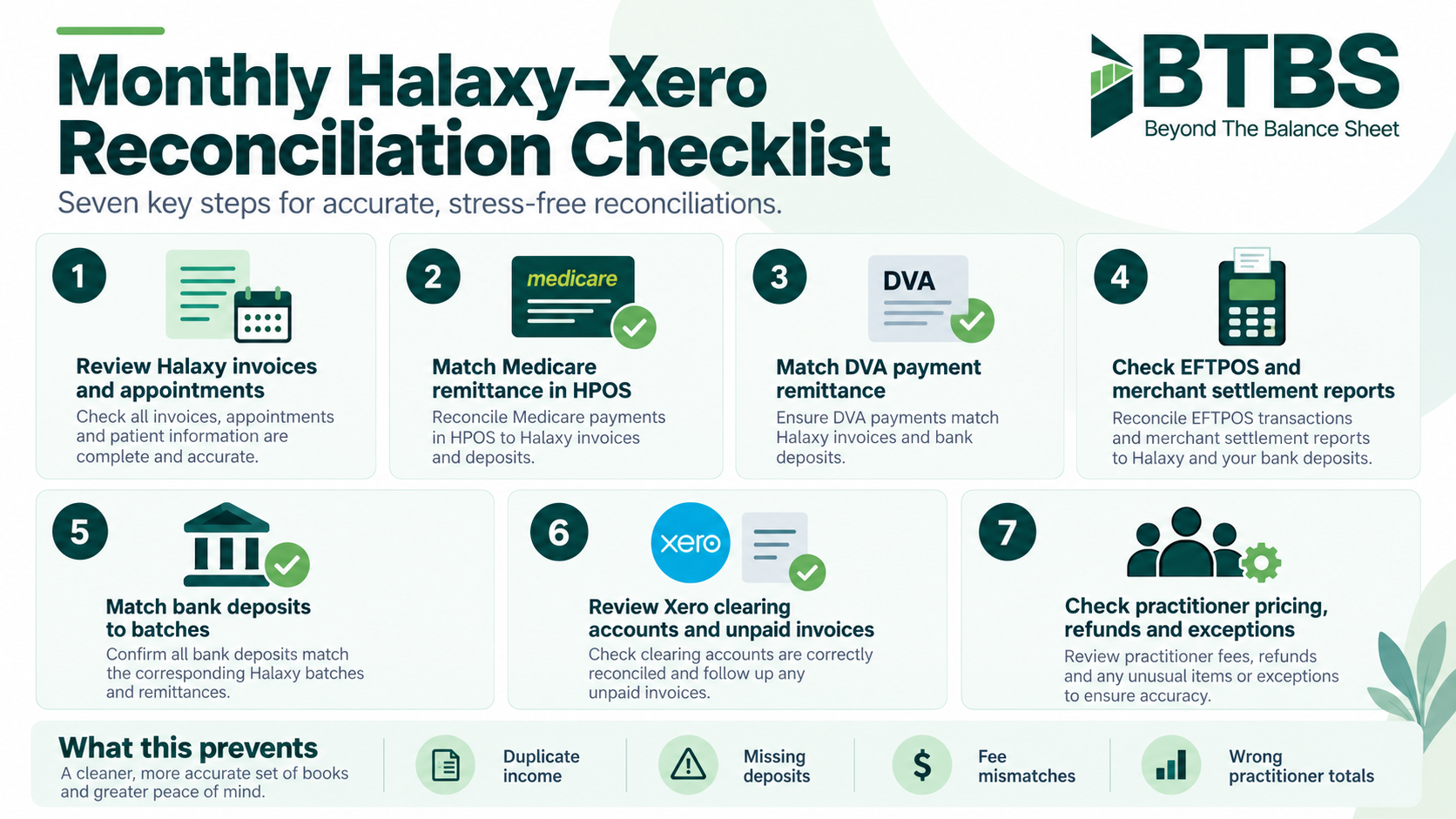
A practical monthly reconciliation process
Step 1: Review Halaxy invoices and appointments
Step 2: Separate payment streams
Step 3: Match private settlements
Step 4: Match Medicare remittance and receipts
Step 5: Match DVA remittance and receipts
Step 6: Reconcile clearing accounts
Step 7: Review unpaid or partially paid invoices
Step 8: Review by practitioner or service line
What should you review in Xero?
7. Reporting by practitioner or service type
Is the problem bookkeeping, workflow or systems design?
How BTBS helps allied health practices
Why does Halaxy show a payment, but Xero still shows the invoice as outstanding?
Do Halaxy and Xero always match exactly day by day?
Can Medicare and DVA cause reconciliation issues?
Should a clearing account always be zero?
What if different practitioners charge different prices?
Can BTBS help if the books are behind and we are not sure where the mismatch started?
What if your practice management system says the money is there, but Xero does not seem to agree?
That is a common issue for growing allied health practices.
A physiotherapy, chiropractic, psychologist, podiatrist, doctors, or multidisciplinary clinic can be very busy, invoices can be raised correctly, appointments can be full, and payments can still become difficult to reconcile once they flow through different channels.
Private patients may pay by EFTPOS or card.
Medicare claims may be submitted through HPOS.
DVA payments may arrive separately.
Merchant fees may be deducted before settlement.
Some amounts may hit the bank today, while others arrive tomorrow or next week.
So when the owner or practice manager opens Xero, the question becomes:
“Why do the numbers in Halaxy, Xero and the bank not line up?”
In many cases, the issue is not that income is missing.
The real issue is that:
the systems record different parts of the transaction
the timing of deposits is different
payments are batched into bank deposits
clearing accounts are not being used or reconciled properly
multiple practitioners and different fee structures make reporting harder
the practice has grown faster than the finance workflow behind it
This article explains how Halaxy and Xero work together, why differences happen, and what an allied health practice should review each month to keep the numbers reliable.
What is the Halaxy and Xero integration?
Halaxy is designed to help practices manage appointments, patient records, invoices and payments.
Xero is your accounting system. It is where your bank feeds, reconciliation, financial reporting, BAS records and management reports sit.
When Halaxy is connected to Xero, the goal is simple:
your practice operations happen in Halaxy, and the financial effect flows into Xero clearly enough for your books and reports to be trusted.
That sounds simple, but in practice, reconciliation issues usually arise because the two systems are not doing exactly the same job.
Halaxy focuses on clinical and billing workflow.
Xero focuses on accounting records and financial reporting.
Your bank feed shows cash movements.
Those are three different views of the same business.
That is why an integration is helpful - but it still needs a proper reconciliation process.
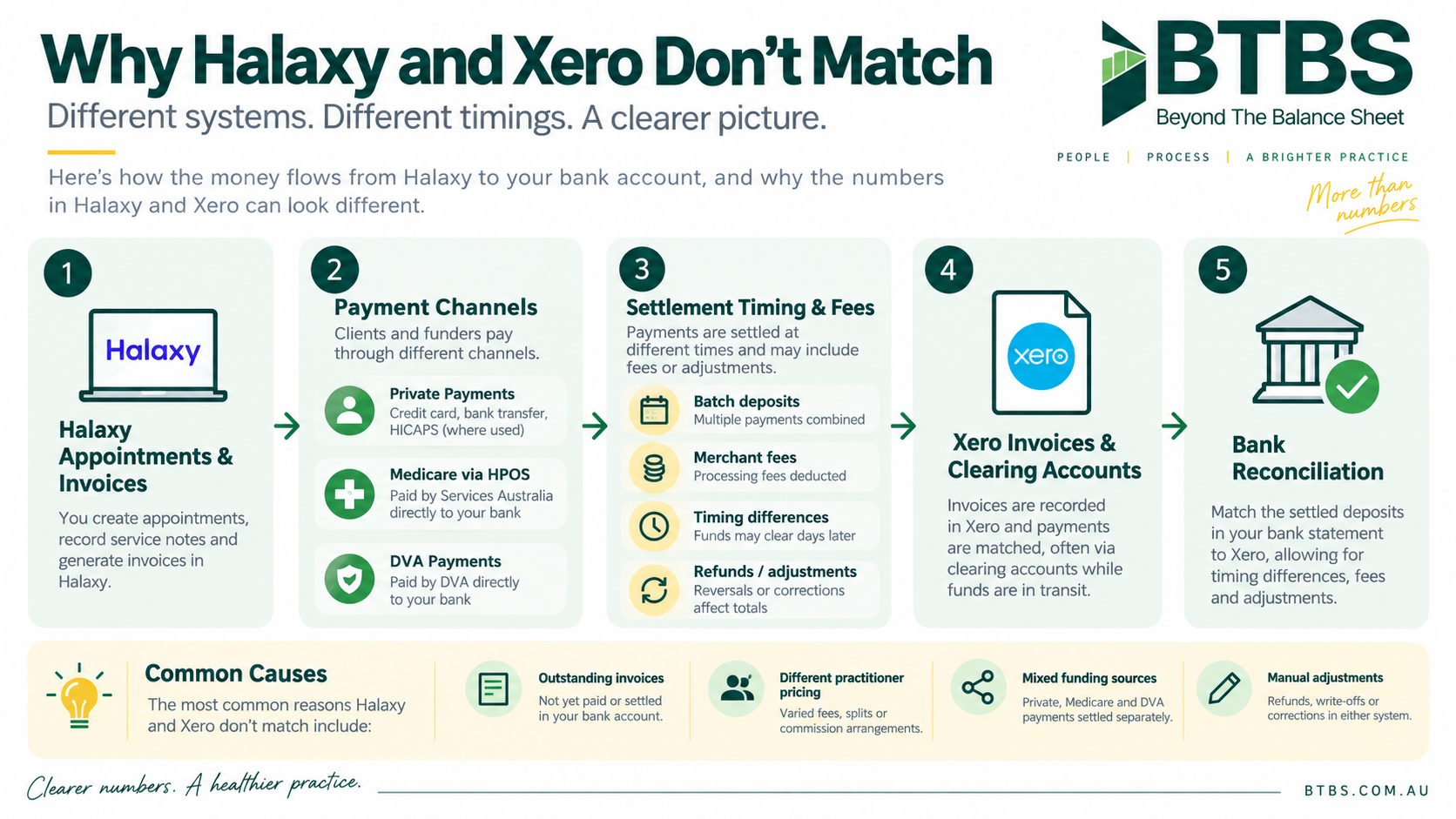
Why Halaxy and Xero don’t always match
A mismatch between Halaxy and Xero does not automatically mean there is an error.
Often, it means the practice is comparing numbers that are at different stages of the payment cycle.
For example:
Halaxy may show an invoice has been created
Xero may show the invoice has synced
the payment may be recorded against the invoice
the bank may receive one batched deposit instead of many individual payments
fees may be deducted before the final settlement reaches the bank
Medicare or DVA claims may be paid in a different batch or on a different day
So the question is not only:
“Did the invoice sync?”
The better question is:
“Can we follow the money from appointment to invoice to payment to bank deposit to Xero reconciliation?”
The most common reasons Halaxy and Xero do not match
1. Different timing
A payment may be recorded in Halaxy today but may not appear in the bank until a later settlement date.
2. Batched deposits
The bank often receives one combined deposit rather than one deposit per invoice.
3. Merchant fees
Card fees may be deducted before the net amount reaches the bank.
4. Medicare and DVA payments
These may follow different claiming and payment paths from ordinary private payments.
5. Outstanding invoices
An appointment may be completed, but the payment may still be unpaid, partially paid or awaiting claim processing.
6. Clearing accounts not being reviewed
If clearing accounts are used but not reconciled properly, balances can build up and confuse reporting.
7. Manual adjustments, refunds or write-offs
These can create differences if they are recorded in one system and not reflected properly in the other.
8. Multiple practitioners and pricing models
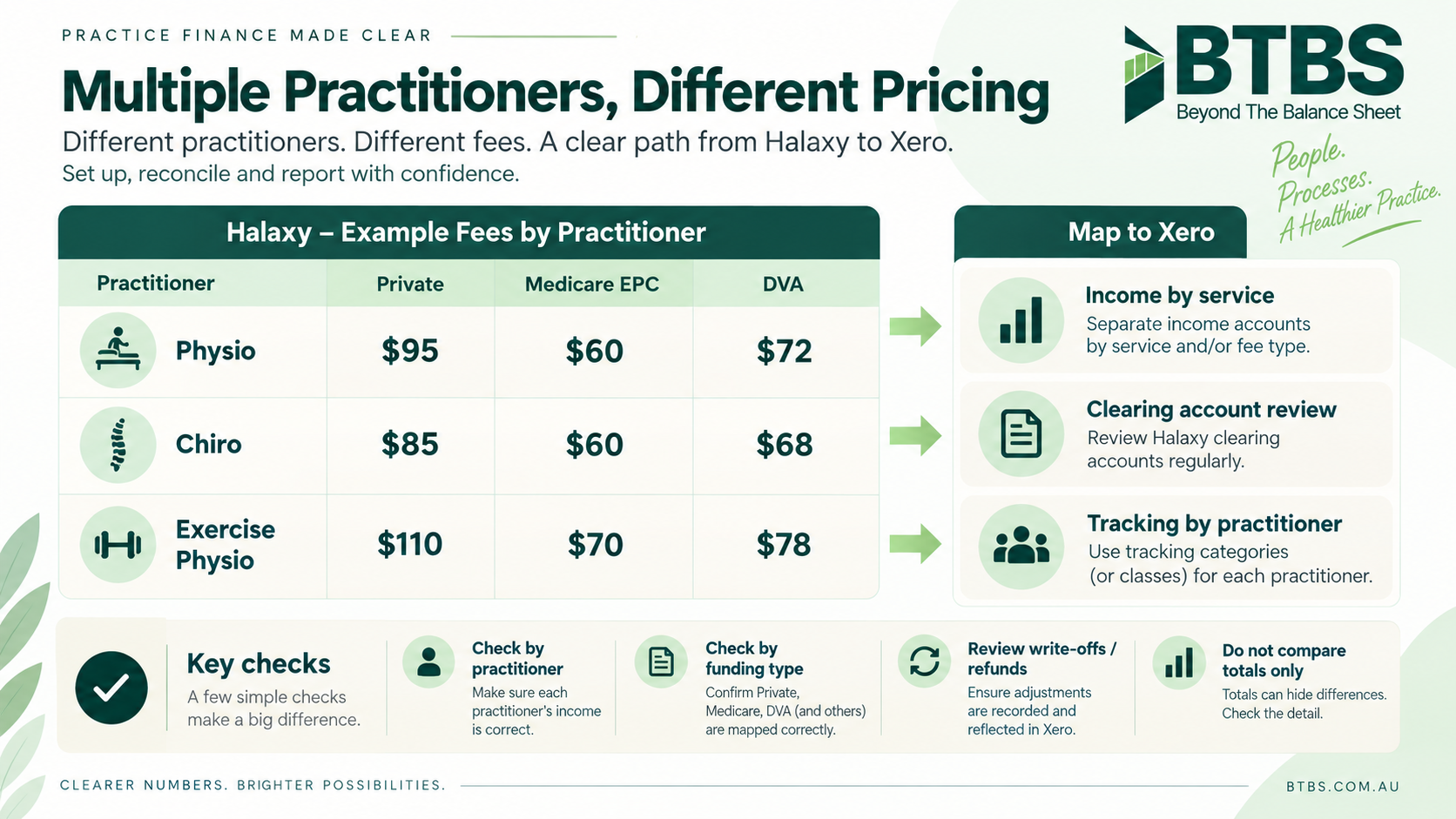
If one clinic has physiotherapists, chiropractors, exercise physiologists or massage therapists charging different rates, totals can look confusing unless the income mapping and reporting structure are clear.
How Medicare and DVA payments affect reconciliation
This is where many allied health practices become stuck.
A clinic may have:
private fees
EPC / Medicare-related claiming workflows
DVA claims
mixed patient gaps and third-party amounts
practitioners with different provider numbers or service types
That means the money is not always flowing through one clean payment path.
Medicare through HPOS
Practices using Health Professional Online Services (HPOS) for Medicare-related claiming need to understand that:
the claim workflow sits within the government claiming environment
payment timing can differ from private payments
remittance information and bank deposits may need to be matched back carefully
the amount shown in Halaxy at invoice level may not equal the exact bank deposit received on that same day
If the clinic owner only compares:
Halaxy invoice total
vs
today’s bank deposit
they may think money is missing when the real issue is timing or settlement structure.
DVA payments
DVA can add another layer.
A DVA service may be invoiced correctly in Halaxy, but the payment flow, remittance and deposit path can differ from a standard private patient transaction.
If DVA claims, remittances or banking details are not reviewed closely, practices can end up with:
old invoices still appearing unpaid
deposits that are difficult to trace
differences between service totals and cash received
confusion between patient-funded, Medicare-funded and DVA-funded services
The practical lesson
A clinic that claims Medicare and DVA should not rely on a single “income total” comparison.
It should reconcile by payment channel:
private payments
Medicare-related claims
DVA-related claims
merchant settlements
refunds or adjustments
That gives the practice a much clearer picture.
Why bank deposits can differ from invoice totals
Many practice owners expect the bank deposit to match the day’s invoices exactly.
In reality, that often does not happen.
Here is why.
Private payment example
Let us say your clinic invoices $4,500 of private consults on Monday.
That does not automatically mean $4,500 will hit the bank on Monday.
Possible differences include:
some patients paid later
some paid by card, with settlement the next day
merchant fees were deducted
one patient was refunded
one insurer or third-party amount remains outstanding
So the bank may receive a net amount that is lower, later, or grouped differently from the invoice total.
That is why the right comparison is not:
daily invoices vs daily bank balance
It is:
invoice detail + payment detail + remittance/settlement detail + bank deposit + Xero reconciliation
Once that workflow is clear, the numbers start making sense.
Multiple practitioners and different pricing structures
This is a major issue for growing practices.
A clinic may have:
a senior physio charging one rate
a junior physio charging another rate
a chiropractor with a different fee structure
an exercise physiologist with a separate funding mix
some practitioners working under revenue share or contractor-style arrangements
some services attracting Medicare or DVA funding while others are private only
If all of that income simply lands in one generic sales account, the practice can still lodge BAS and reconcile the bank — but management reporting becomes weak.
The owner then struggles to answer practical questions like:
Which practitioner is generating the strongest revenue?
Are some fees set too low?
Is the clinic collecting the right amount from each payment stream?
Are Medicare and DVA services profitable after admin time and compliance effort?
Are practitioner splits and exceptions being handled consistently?
A better approach
Where the workflow suits the practice, Xero can be structured so the owner can review income more clearly by:
service type
funding type
practitioner
location or division
The exact structure depends on how the clinic operates, but the principle is simple:
do not only record income - structure it so you can understand it.
That becomes even more important when practitioners have different pricing.
A practical example: why the clinic feels busy but the numbers feel messy
Let us take a simple example.
A Brisbane allied health clinic has:
2 physiotherapists
1 chiropractor
1 exercise physiologist
During one week, Halaxy shows the following invoiced activity:
Private consults: $8,200
Medicare-related services: $2,400
DVA services: $1,600
Total invoiced: $12,200
The owner expects the bank to reflect around $12,200.
But the bank only shows:
Card settlement net of fees: $7,920
Medicare deposit received this week: $1,800
DVA deposit received this week: $1,200
Total cash received this week: $10,920
So the owner thinks:
“We are missing $1,280.”
But when the practice reviews the detail, the explanation is:
$220 merchant fees deducted from private card settlements
$600 Medicare claims submitted but not yet received
$400 DVA claims not yet deposited
$60 patient invoice still unpaid
Nothing is necessarily missing.
The issue is that different parts of the payment cycle were compared as if they were the same thing.
That is exactly why clinics need a proper reconciliation workflow between Halaxy, Xero and the bank.
A practical monthly reconciliation process
A practice does not need a complicated finance department to improve this.
What it needs is a repeatable month-end review.
Step 1: Review Halaxy invoices and appointments
Check that:
appointments were invoiced correctly
cancelled or rescheduled appointments were handled correctly
practitioners were recorded correctly
the patient, organisation or funding body details are accurate
Step 2: Separate payment streams
Break the month into payment categories such as:
private patient payments
Medicare-related claim receipts
DVA receipts
third-party or insurer payments
refunds and adjustments
Step 3: Match private settlements
Review EFTPOS/card settlements and identify:
gross takings
fees deducted
net banked amount
settlement dates
Step 4: Match Medicare remittance and receipts
Review the relevant claim records and deposits so that the amount received can be matched back to the related invoicing period.
Step 5: Match DVA remittance and receipts
Check DVA claims and corresponding deposits, especially where there may be timing differences.
Step 6: Reconcile clearing accounts
If a clearing account method is being used, the balance should be understandable and reviewed regularly. Old balances should not simply accumulate.
Step 7: Review unpaid or partially paid invoices
Follow up:
unpaid patient gaps
claim exceptions
incorrectly allocated receipts
duplicates, reversals or credits
Step 8: Review by practitioner or service line
This is where the practice owner moves beyond bookkeeping and into management accounting.
You want to know:
who generated the revenue
what type of work drove it
whether pricing still makes commercial sense
where admin friction or write-offs are happening
What should you review in Xero?
Once Halaxy is working operationally, Xero still needs to be reviewed properly.
A practice should regularly review:
1. Bank reconciliation
Not just whether the bank is “reconciled”, but whether the coding and matching actually make sense.
2. Unpaid sales invoices
Especially invoices that appear old, duplicated or inconsistent with Halaxy.
3. Clearing accounts
These should not build up unexplained balances over time.
4. Merchant fee treatment
Net deposits should not hide the real fee expense.
5. Income structure
Income may need clearer coding by service type, payer type or practitioner for better reporting.
6. Exceptions and adjustments
Refunds, credits, reversals and write-offs should be visible and explained.
7. Reporting by practitioner or service type
As the practice grows, the owner usually needs more than one total revenue number.
Is the problem bookkeeping, workflow or systems design?
This is one of the most important questions.
Sometimes the problem is bookkeeping.
Sometimes it is the way the team is using Halaxy.
Sometimes it is the Xero mapping.
Sometimes it is the reporting structure.
Sometimes it is all of them together.
For example:
if invoices are correct but the clearing account never clears, it is a reconciliation issue
if claims are lodged correctly but not mapped clearly for reporting, it is a systems structure issue
if practitioner income cannot be reviewed properly, it is a reporting design issue
if the practice has grown and the admin process stayed manual, it is a workflow issue
That is why a practice should not only ask:
“Can someone do the bookkeeping?”
It should ask:
“Can we trust the way our systems, payments and reports are working together?”
How BTBS helps allied health practices
At Beyond The Balance Sheet, we help growing businesses review the systems and financial processes behind their numbers.
For allied health practices, that can include:
Halaxy and Xero workflow review
reconciliation cleanup
Medicare, DVA and payment-channel review
clearing account design
reporting improvement
practitioner-level visibility
process training for the team
ongoing accounting systems support
Our approach is practical:
Review → Reconcile → Integrate → Train → Maintain
The goal is not just to get the books up to date.
The goal is to give the practice owner reliable financial information they can actually use.
Frequently Asked Questions
Why does Halaxy show a payment, but Xero still shows the invoice as outstanding?
Usually because the timing, sync status or reconciliation process has not fully caught up. The payment may exist in Halaxy, but the corresponding settlement, sync, or matching process in Xero may still need review.
Do Halaxy and Xero always match exactly day by day?
Not necessarily. Different payment channels, settlement timing, merchant fees, Medicare receipts and DVA deposits can all create normal timing differences.
Can Medicare and DVA cause reconciliation issues?
Yes. They often create additional steps and timing differences compared with ordinary private patient payments. That does not automatically mean the books are wrong, but it does mean the reconciliation process must be clear.
Should a clearing account always be zero?
Not always at every moment, because transactions may still be in transit. But it should be reviewed regularly, and old or unexplained balances should not be left sitting there month after month.
What if different practitioners charge different prices?
That is common. The key is to set up your systems and reports so income can be reviewed properly by practitioner, service type and funding stream where needed.
Can BTBS help if the books are behind and we are not sure where the mismatch started?
Yes. The first step is to review the current workflow, identify where the mismatch is happening, and determine whether the issue is in Halaxy, Xero, the payment channel, or the reconciliation process.
Do we need to wait until BAS time to fix this?
No. In fact, it is much better to fix it before BAS, year-end or tax time, because once the reporting backlog builds up, the clean-up becomes harder.
Final thought
A healthy practice needs more than full appointment books.
It needs financial systems that make the numbers understandable.
When Halaxy, Xero, Medicare-related receipts, DVA receipts and bank deposits are not being connected properly, the owner loses visibility.
And when visibility drops, decision-making becomes harder.
That affects:
cash flow
confidence in the reports
pricing decisions
practitioner performance review
owner peace of mind
If your practice is growing and you are no longer sure whether Halaxy, Xero and the bank are telling the same story, that is usually the right time to review the system behind the numbers.
Not sure whether the problem is Halaxy, Xero, HPOS, DVA reconciliation or the process behind it?
Beyond The Balance Sheet helps growing businesses review and improve the financial systems and processes behind their numbers.
Explore our Xero Bookkeeping & Accounting Systems services.
You may also find our related guide helpful:
Xero Health Check: Can You Trust Your Numbers?
Melbourne-based, supporting businesses across Australia.
Last reviewed: September 2026