
Profitable but No Cash? Why Your Business Can Make Money and Still Feel Broke
Profitable but No Cash? Why Your Business Can Make Money and Still Feel Broke
What is the difference between profit and cash flow?
How can a profitable business run out of cash?
1. Customers have not paid you yet
2. Inventory or work in progress is absorbing cash
3. Loan principal repayments use cash
4. Equipment purchases use cash
5. GST, PAYG, super and tax obligations fall due
6. Owners take money from the business
7. Growth itself can consume cash
Practical example: $120,000 profit — but where did the cash go?
Where should you look in Xero when profit is positive but cash is low?
Inventory and work in progress
Is the problem profitability or cash flow?
What is a 13-week cash-flow forecast?
What should a business owner monitor every month?
What can improve business cash flow?
Collect customer invoices faster
Review supplier and payment timing
Model growth before committing
How BTBS approaches profit and cash-flow problems
1. Establish whether the numbers are reliable
3. Identify where cash is being absorbed
Can a profitable business still run out of cash?
Why does my Profit & Loss show profit when my bank balance is low?
Is cash flow more important than profit?
Does increasing sales always improve cash flow?
How far ahead should a business forecast cash?
How often should a cash-flow forecast be updated?
Can Xero tell me why my business has no cash?
A business owner opens the Profit & Loss and sees a healthy profit.
Then they look at the bank account and ask:
“If the business made money, where did all the cash go?”
It is one of the most important financial questions a growing business can ask.
And the answer starts with a simple principle:
Profit and cash are not the same thing.
A business can be profitable and still experience significant cash pressure.
Why?
Because profit measures financial performance over a period, while cash flow measures when money actually enters and leaves the business.
For a growing business, understanding the relationship between the two is critical.
At Beyond The Balance Sheet, we look beyond the bottom line and connect:
Profit → Balance Sheet → Working Capital → Cash Flow → Forecast → Decision
The objective is not simply to know whether the business made money.
It is to understand:
Where is the cash? What is consuming it? What happens next?
What is the difference between profit and cash flow?
Profit tells you whether the business generated an accounting surplus over a period. Cash flow tells you what money actually moved into and out of the business.
A Profit & Loss generally shows:
Revenue
less
Cost of Sales
less
Operating Expenses
=
Profit
But the bank account is affected by transactions that may not appear in the Profit & Loss at the same time - or may not appear there at all.
For example:
customers may still owe you money
inventory may be sitting unsold
loan principal may be repaid
equipment may be purchased
GST, PAYG, super and tax obligations may fall due
owners may withdraw or distribute cash
the business may need to fund growth before customers pay
Under accrual reporting, revenue and expenses may be recognised before the related cash is received or paid.
That timing difference is one major reason why:
Accounting profit ≠ cash in the bank.
How can a profitable business run out of cash?
Usually there is not just one reason.
Several cash-flow drivers can occur at the same time.
1. Customers have not paid you yet
Under accrual reporting, a sale can contribute to revenue and profit before the customer pays the invoice.
Imagine you issue a customer invoice for:
$50,000
The revenue may appear in your Profit & Loss.
But the customer has 30-day payment terms.
Meanwhile, the business still needs to pay:
employees
suppliers
rent
insurance
software
tax obligations
The business has made the sale.
But it has not received the cash yet.
That $50,000 may instead be sitting in:
Accounts Receivable / Debtors
on the Balance Sheet.
This is why debtor collection is not merely an administration issue.
It is a working-capital and cash-flow issue.
2. Inventory or work in progress is absorbing cash
Consider an e-commerce or retail business that purchases:
$80,000 of inventory.
The business may pay the supplier before those products are sold.
Cash has already left the bank.
But depending on the accounting treatment, unsold inventory may remain on the Balance Sheet as an asset rather than immediately becoming an expense in the Profit & Loss.
The same economic principle can affect project and construction businesses.
Cash may be spent on:
materials
labour
subcontractors
project costs
before the business receives the corresponding customer payment.
The business is effectively funding the gap.
That money becomes tied up in working capital.
3. Loan principal repayments use cash
This is another common source of confusion.
Suppose your monthly business loan repayment is:
$5,000
That payment consists of:
Interest: $1,000
Principal: $4,000
The interest component normally affects profit.
But the principal repayment generally reduces the loan liability on the Balance Sheet.
The full $5,000 leaves the bank.
Only the interest component is ordinarily reflected as an expense in the Profit & Loss.
Therefore:
Cash can fall by $5,000 while the P&L only shows $1,000 of expense.
The other $4,000 has not disappeared.
It has reduced the amount the business owes.
4. Equipment purchases use cash
Suppose the business purchases equipment costing:
$30,000.
The business may pay $30,000 immediately.
But for accounting purposes, a capital asset may be recorded on the Balance Sheet and recognised as an expense progressively through depreciation rather than having the entire purchase immediately reduce accounting profit.
The precise accounting and tax treatment depends on the asset and circumstances.
But the cash-flow principle is clear:
Cash may leave today even though the Profit & Loss does not show the full $30,000 as today's expense.
This commonly occurs when growing businesses invest in:
vehicles
machinery
fit-outs
computer equipment
technology
other capital assets
5. GST, PAYG, super and tax obligations fall due
One of the most dangerous assumptions a business owner can make is:
“If the money is in the bank, we can spend it.”
Not necessarily.
Part of that cash may need to fund upcoming obligations such as:
GST
PAYG withholding
superannuation
PAYG instalments
income tax
payroll-related liabilities
The ATO specifically recommends setting aside amounts such as GST, PAYG withholding and super from cash flow so funds are available when payment is due.
This creates an important distinction:
Bank balance
is not necessarily the same as
Available operating cash.
6. Owners take money from the business
Cash may also leave the business through owner-related transactions.
The accounting and tax treatment depends heavily on the business structure and the nature of the transaction.
For example, money taken from a sole trader business may be treated differently from:
dividends
shareholder loans
director-related payments
partnership drawings
But from a cash-flow perspective, the first question is simple:
Did cash leave the business?
If significant amounts are being withdrawn, distributed or transferred to owners, the business may be profitable while its available cash continues to decline.
This is why owner extraction needs to be considered alongside business cash requirements.
7. Growth itself can consume cash
This is one of the most important lessons for a growing business.
Growth does not always create cash immediately.
Sometimes growth consumes cash first.
Imagine winning a major new contract.
Before receiving the customer's money, you may need to fund:
additional staff
materials
subcontractors
inventory
equipment
larger premises
software
insurance
marketing
payroll
GST and other obligations
Revenue increases.
Profit may increase.
But the business requires more working capital to support the additional activity.
This creates a counter-intuitive situation:
A rapidly growing profitable business can experience more cash pressure than a smaller stable business.
Growth therefore needs to be funded, not merely celebrated.
Practical example: $120,000 profit — but where did the cash go?
Illustrative example only.
Assume a business reports:
Accounting profit: $120,000
The owner expects the bank account to have increased by approximately $120,000.
But consider this simplified bridge:
Movement | Approximate cash effect |
|---|---|
Accounting profit | +$120,000 |
Add back depreciation — non-cash expense | +$10,000 |
Increase in accounts receivable | -$35,000 |
Increase in inventory | -$20,000 |
Increase in prepaid/other working capital | -$5,000 |
Increase in accounts payable | +$8,000 |
Loan principal repayments | -$18,000 |
Equipment purchased | -$25,000 |
Owner withdrawals/distributions | -$15,000 |
Illustrative increase in cash | +$20,000 |
The business reported $120,000 accounting profit.
But in this simplified example, cash increased by only $20,000.
Nothing necessarily went missing.
The money was absorbed by:
customers owing more money + more inventory + loan repayments + capital investment + owner withdrawals.
This is why the question:
“Did we make a profit?”
needs to be followed by:
“What happened to the cash generated by that profit?”
PROFIT ≠ CASH
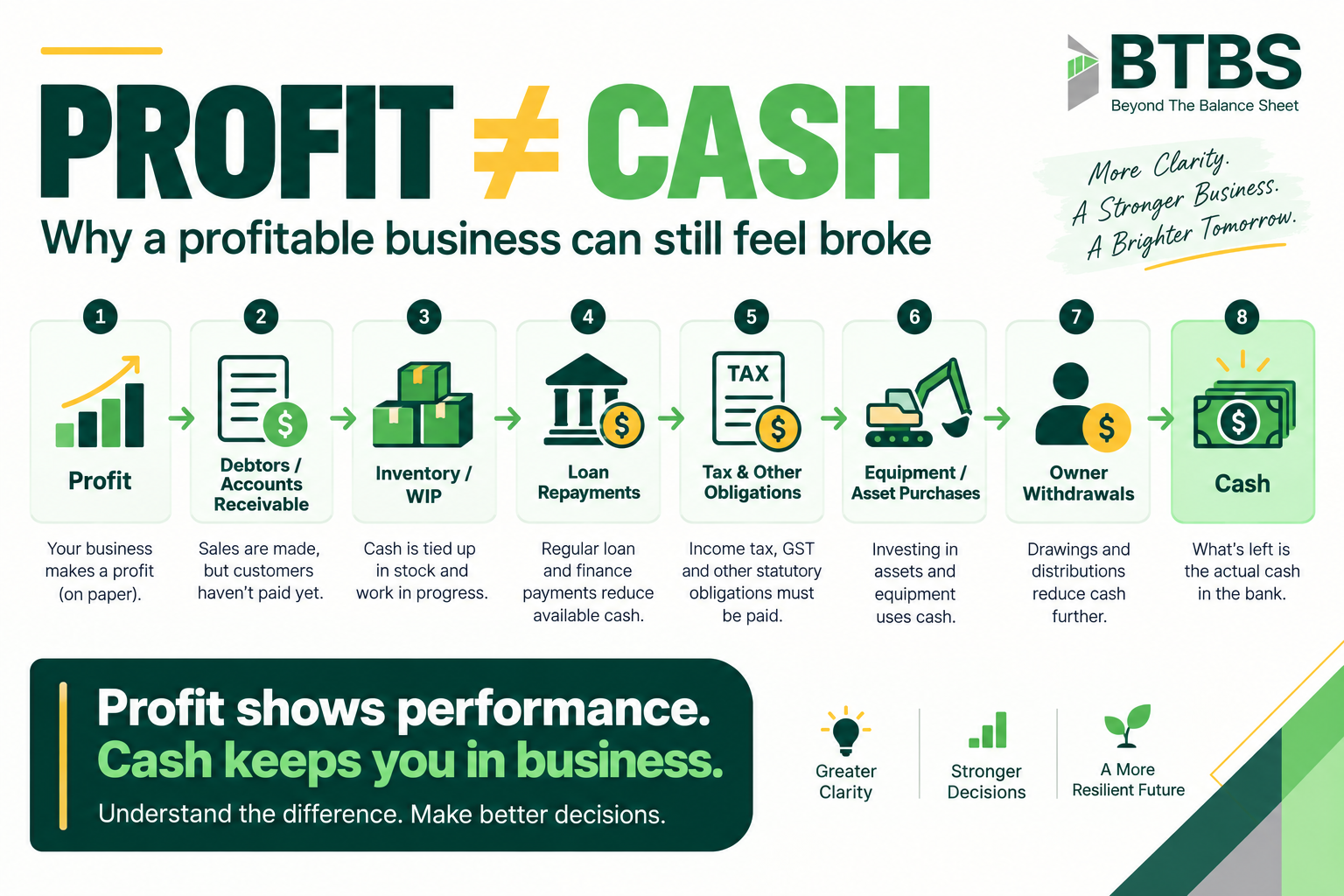
The Profit & Loss tells only part of the financial story.
To understand cash properly, management often needs to look across the Profit & Loss, Balance Sheet and cash-flow forecast together.
Where should you look in Xero when profit is positive but cash is low?
Do not immediately conclude that the business is unprofitable.
Start by reviewing the financial reports together.
Profit & Loss
Ask:
Is revenue increasing or decreasing?
What is happening to gross profit?
Are wages rising faster than revenue?
Are overheads increasing?
Is the underlying business actually profitable?
The first question is still:
Does the business model make money?
Accounts receivable
Then ask:
How much do customers currently owe?
How much is overdue?
Is the debtor balance increasing?
Are customers taking longer to pay?
Are large invoices concentrated with a few customers?
If revenue rises from $1 million to $1.5 million but debtors also rise significantly, some of that growth may not yet have reached the bank.
Inventory and work in progress
Look for cash tied up in:
unsold stock
slow-moving stock
project costs
unbilled work
materials purchased ahead of revenue
The question becomes:
How long does cash remain invested before it returns to the bank through a customer payment?
Balance Sheet
This is where many answers to:
“Where did the money go?”
can be found.
Review movements in:
accounts receivable
accounts payable
inventory
loans
fixed assets
GST and tax liabilities
payroll liabilities
owner/shareholder-related balances
bank accounts
The Profit & Loss tells you about performance.
The Balance Sheet helps explain what the business currently owns, owes and has tied up.
Cash-flow forecast
Historical reports answer:
“What happened?”
Cash-flow forecasting asks:
“What happens next?”
That is a different management question.
Australian Government guidance recommends using cash-flow forecasts to estimate future receipts and costs and identify potential cash shortages and surpluses before they occur.
Is the problem profitability or cash flow?
This distinction matters because the solution is different.
What you see | What may need investigation |
|---|---|
Sales strong but gross margin weak | Profitability |
Prices do not adequately cover labour and overhead | Profitability |
Profit positive but customers pay slowly | Cash flow / working capital |
Inventory growing much faster than sales | Cash flow / working capital |
Large loan repayments coming due | Financing / cash flow |
Tax liabilities accumulating without reserves | Cash planning |
Revenue growing rapidly while cash falls | Growth / working capital |
Profit and cash both declining | Broader financial performance |
A profitability problem may require attention to:
Price → Volume → Gross Margin → Labour → Overheads → Productivity
A cash-flow problem may require attention to:
Debtors → Inventory → Payment timing → Tax reserves → Debt → Working capital
Sometimes the business has both.
That is why:
Diagnosis should come before action.
What is a 13-week cash-flow forecast?
A 13-week cash-flow forecast is a commonly used short-term management tool that estimates cash receipts and payments over approximately the next three months.
It answers practical questions such as:
How much cash do we have now?
What money should arrive next week?
What major payments are coming?
Will payroll and BAS fit comfortably?
When could cash become tight?
What can management do before that happens?
A simple structure is:
Opening Cash
+
Expected Cash In
−
Expected Cash Out
=
Forecast Closing Cash
Cash coming in might include:
expected customer receipts
recurring revenue
deposits
financing
other known inflows
Cash going out might include:
payroll
supplier payments
rent
loan repayments
GST/PAYG/tax
superannuation
equipment purchases
subscriptions
major commitments
A forecast is not a guarantee.
It is a decision-making model based on the information and assumptions available today.
It becomes useful because management can update it when reality changes.
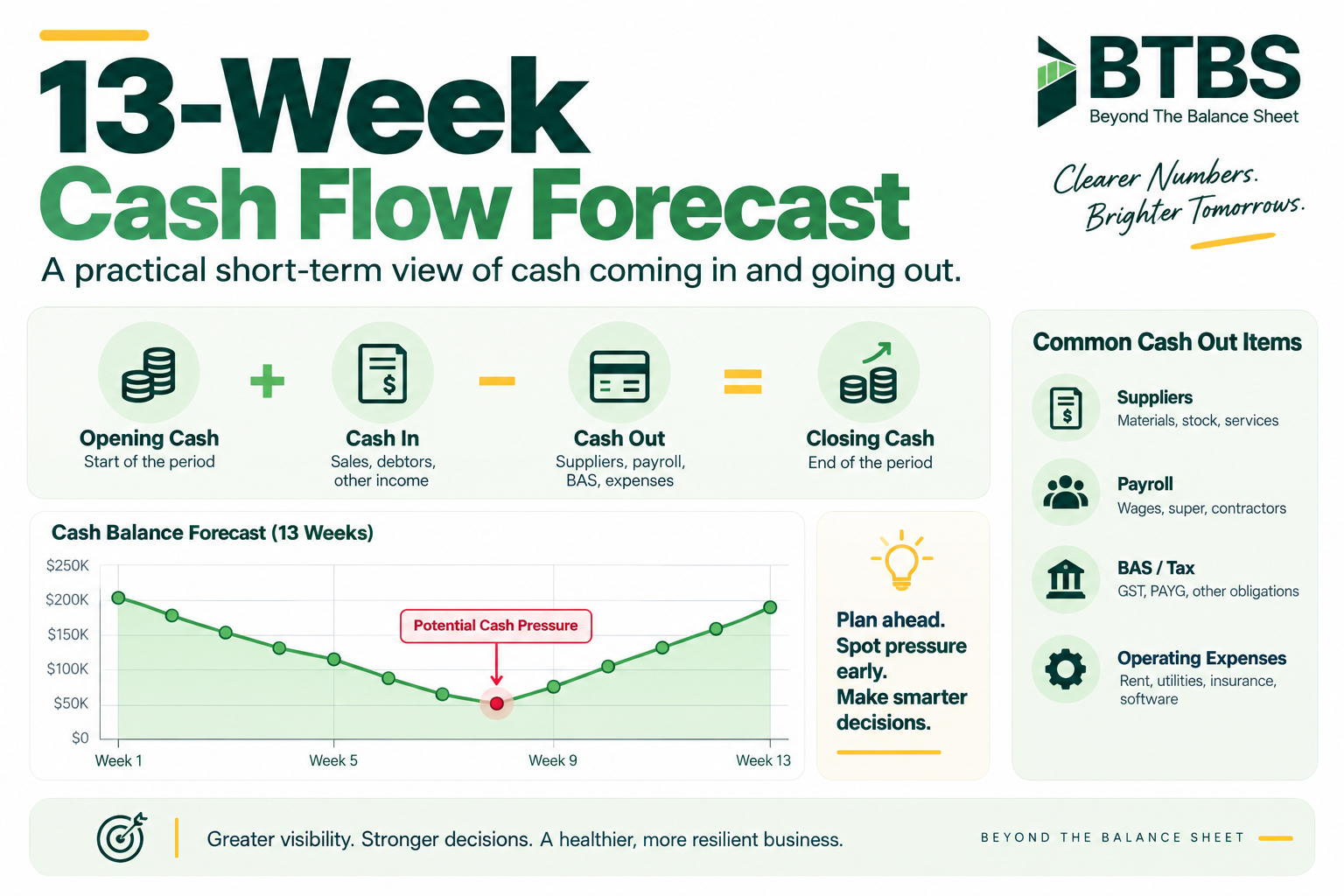
The value is not merely knowing that cash may become tight.
The value is seeing the problem early enough to act.
For example:
Week 1: healthy cash
↓
Week 5: cash gradually declining
↓
Week 9: large commitments approaching
↓
Week 11: potential cash pressure
Management now has time to consider options before the shortfall arrives.
What should a business owner monitor every month?
A useful management review goes beyond asking:
“What's the profit?”
Depending on the business, I would want the owner to understand these areas.
Revenue
What did we sell?
Is revenue:
growing
declining
seasonal
concentrated
changing by location, customer, product or service?
Gross profit
What margin remains after the direct cost of delivering the sale?
Revenue growth without sufficient gross margin may create more work without creating enough profit.
Labour
For many service businesses, labour is one of the largest costs.
Ask:
Is labour growing in proportion to revenue and productive capacity?
Operating profit
After direct costs, labour and overheads:
Is the core business model producing an acceptable return?
Working capital
How much cash is tied up in:
customers who have not paid
inventory
work in progress
other short-term operating balances?
Cash
What is genuinely available today?
Not just:
“What does the bank app say?”
But:
“What part of that cash is already committed?”
Forecast
What is likely to happen over the next 13 weeks?
This is where historical accounting begins to become forward-looking management information.
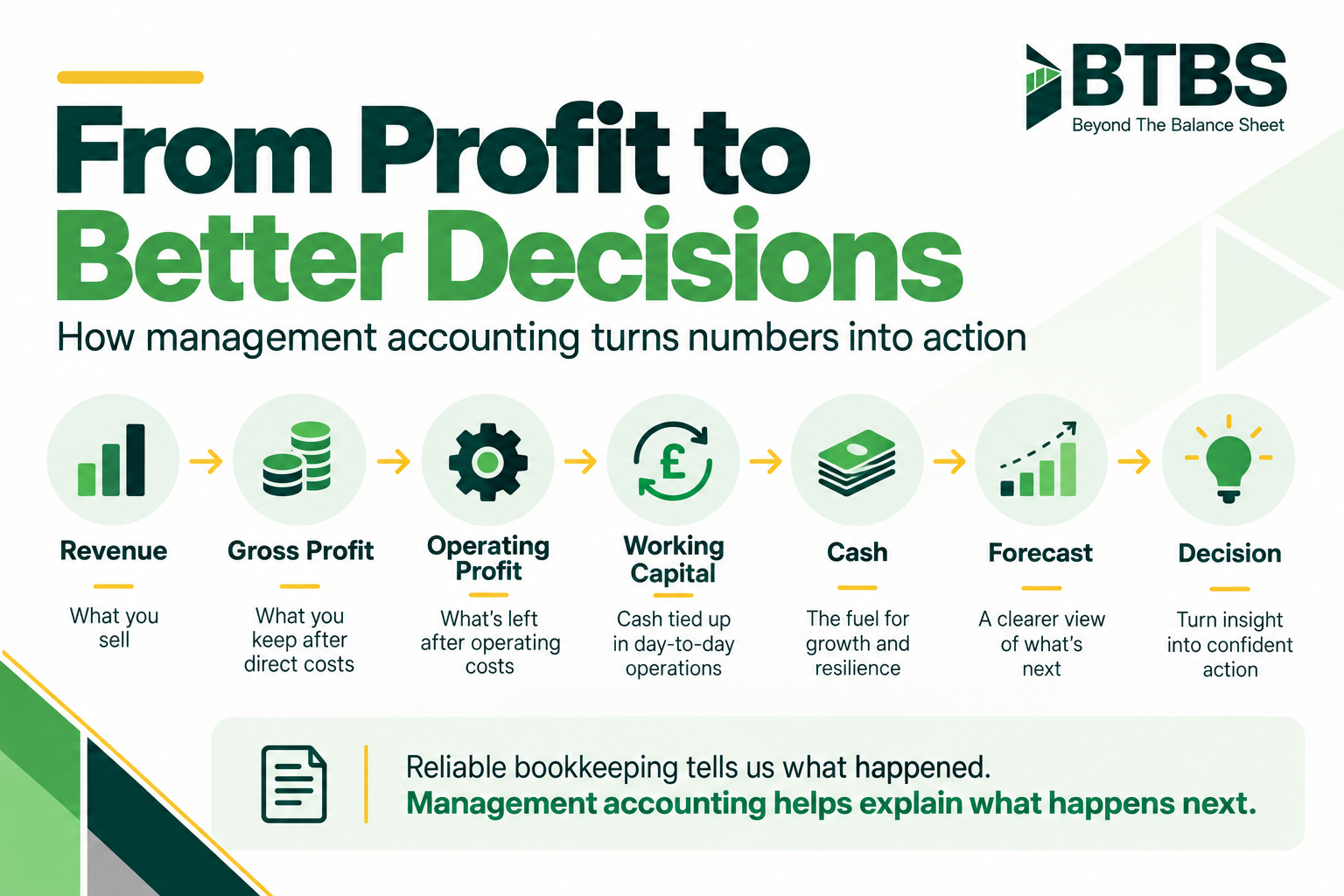
This is the journey I want a growing business owner to understand:
Revenue
↓
Gross Profit
↓
Operating Profit
↓
Working Capital
↓
Cash
↓
Forecast
↓
Decision
Reliable bookkeeping tells us what happened.
Management accounting helps us understand:
Why did it happen?
What is driving the result?
What is likely to happen next?
What decision should management consider?
What can improve business cash flow?
There is no universal answer because cash-flow problems have different causes.
But common management levers include:
Collect customer invoices faster
Review:
when invoices are issued
payment terms
overdue accounts
deposit requirements
collection processes
Reducing debtor days can release cash already earned by the business.
Review pricing and margin
More sales are not automatically better.
If every additional sale carries insufficient margin, increasing volume may increase workload and working-capital requirements without materially improving cash.
Manage inventory carefully
Excess inventory ties up cash.
Review:
stock turnover
slow-moving inventory
purchasing quantities
reorder policies
seasonal stock requirements
Plan major expenditure
Understand the impact of:
equipment
vehicles
technology
premises
fit-outs
before committing cash.
Review supplier and payment timing
Understand when cash leaves relative to when customers pay.
The goal is not simply to delay suppliers.
It is to manage working capital responsibly and maintain sustainable supplier relationships.
Reserve cash for obligations
GST, PAYG withholding, super and other obligations should be planned rather than discovered at payment time.
The ATO specifically recommends using cash-flow budgeting or projections to identify cash needs and plan for tax and major expenses.
Model growth before committing
Before adding:
staff
locations
inventory
equipment
major contracts
ask:
How much cash will we need before the additional revenue actually arrives?
That is where forecasting becomes particularly valuable.
How BTBS approaches profit and cash-flow problems
At Beyond The Balance Sheet, we do not start by looking at the bank balance alone.
We work through the financial story in sequence.
1. Establish whether the numbers are reliable
Before analysing profitability or cash, the underlying accounting information needs to be dependable.
This may involve reviewing:
reconciliations
Balance Sheet accounts
bookkeeping
clearing accounts
reporting
system integrations
Check our Xero Health Check Guide here.
2. Understand profitability
Analyse:
Revenue → Gross Profit → Labour → Overheads → Operating Profit
We need to establish whether the business itself is economically performing.
3. Identify where cash is being absorbed
Then investigate:
Debtors → Inventory/WIP → Tax → Loans → Assets → Owner Movements → Working Capital
This explains why accounting profit and available cash may be different.
4. Forecast forward
Historical reporting is not enough when management needs to make a future decision.
A cash-flow forecast provides a forward view of:
expected receipts
expected payments
timing
pressure points
available cash
5. Test decisions
Once the model is established, management can ask:
What happens if revenue grows 15%?
Can we afford another employee?
How much revenue do we need to break even?
What if customers take another 15 days to pay?
What happens if gross margin falls 3%?
Can we afford new equipment?
How much cash reserve should we maintain?
The objective is not another spreadsheet.
The objective is:
better-informed business decisions.
Frequently Asked Questions
Can a profitable business still run out of cash?
Yes.
A business can make an accounting profit while cash is tied up in debtors, inventory or work in progress, or used for loan principal repayments, asset purchases, owner withdrawals and other obligations.
Profitability and liquidity need to be monitored together.
Why does my Profit & Loss show profit when my bank balance is low?
Because the Profit & Loss does not capture every cash movement in the same way.
Review the Balance Sheet and cash-flow movements as well, particularly:
debtors
inventory
loans
capital purchases
tax liabilities
owner-related transactions
Is cash flow more important than profit?
They answer different questions.
Profit helps determine whether the business model is financially sustainable.
Cash flow determines whether the business has sufficient money available at the right time to meet its commitments.
A healthy business generally needs both sustainable profitability and adequate liquidity.
Does increasing sales always improve cash flow?
No.
Growth may initially require additional cash for:
employees
inventory
materials
suppliers
tax
equipment
before customers pay.
Therefore:
Revenue growth needs to be considered alongside margin and working-capital requirements.
How far ahead should a business forecast cash?
The appropriate forecasting horizon depends on the business.
A rolling 13-week cash-flow forecast is commonly used for short-term cash management.
Longer-term forecasts may be appropriate for:
budgets
growth planning
financing
major investment decisions
scenario modelling
How often should a cash-flow forecast be updated?
It should be updated often enough to remain useful.
A business experiencing rapid growth or cash pressure may review it weekly.
A more stable business may incorporate forecasting into its monthly management-reporting process.
Can Xero tell me why my business has no cash?
Xero can provide the underlying financial reports and data.
But understanding why cash changed may require analysis across:
Profit & Loss + Balance Sheet + Receivables + Payables + Loans + Tax + Business Operations
Software produces information.
Management accounting interprets what that information means for the business.
Profitable, but still unsure where the money is going?
You should not have to manage a growing business by checking the bank account and hoping there will be enough cash next month.
Beyond The Balance Sheet helps business owners connect:
Profit → Working Capital → Cash Flow → Forecast → Business Decisions
through management accounting, cash-flow forecasting, break-even analysis, KPI reporting and scenario modelling.
Explore BTBS Business Advisory & Cash Flow Forecasting
Melbourne-based, supporting growing businesses across Australia.
Last reviewed: September 2026
Sources
Australian Government — business.gov.au: Set up a cash flow statement; Set up a profit and loss statement; Create a budget.
Australian Taxation Office: Manage your business cash flow and small-business guidance on reserving cash for GST, PAYG withholding and super obligations.